
1 EARO, Holleta Agricultural Research Center, P.O. Box 2003, Addis Ababa, Ethiopia
2 Awassa College of Agriculture, P.O. Box 5, Awassa, Ethiopia
Abstract
An experiment was carried out using 24 Somali does with the aim of developing a milking technique that optimally balances milk for family use and proper kid growth. Two regimes of partial suckling were used. In the first milking method (MM1), milk was estimated in the morning and late afternoon, and for the second method (MM2) milk was estimated only in the morning after an overnight separation of kids from dams. MM2 provided more milk (21.5%) for dairy use and promoted greater kid growth than MM1. Milking method influenced (P<0.01) the amount of milk harvested by hand only. Weaning weight averaged 27.5% greater for MM2 vs MM1.
Introduction
The small size of goats makes them highly suitable for milk production in areas where land available per household is insufficient for large dairy animals. A survey made by FARM Africa (1996) revealed the importance of goats as milk producing animals. Goat milk is usually part of the staple diet in all pastoral areas and provides the only milk for children of the poorest families in southern Ethiopia. Although the value of goats as milk producing animals has long been realized by pastoralists in the lowlands, such a recognition is a recent development in densely populated regions of Ethiopia where land holding per household is very small and feed supplies are often inadequate to keep dual purpose cattle.
Milk from the dam is a critical dietary component for growing kids because they are entirely dependent on milk until about 8 weeks of age. Intake of solid feed becomes significant as the rumen develops. Until this time, kids must consume either goat milk or an adequate milk replacer. Such replacers, usually made from dried skim cow milk with added fat and carbohydrate of vegetable origin, are not likely to be available and moreover are costly for small-scale farmers in Ethiopia. Newly born kids must therefore rely on the milk of their dams.
In circumstances (small-scale production) where milk is required both for family consumption as well as for proper growth of young kids, a balance must be sought where the two differing production objectives are optimized. Hence, the objective of this study was to identify appropriate milking and(or) suckling methods suitable for small-scale goat milk producers and also for support reasonable kid growth.
Materials and Methods
2.1 Animals and Management
The experiment was started with a total of 24 Somali does with single kids. Most of the does were in their first or second parity and had kidded in almost the same season. Does were divided into two groups considering parity, sex and genotype of the kid. Does were allowed to graze during daytime, and concentrate supplement was provided at 300 g/day. Kids were kept in the barn and were exposed to forage and supplementary concentrate starting at 2 weeks of age.
2.2 Milk Recording
Two regimes of partial suckling were used, starting at approximately 1 week after kidding and lasting for a 16-week period. For does in milking method 1 (MM1), milk was estimated twice daily in the morning (07:00 hour) and late in the afternoon (18:00 hour). Kids were completely separated from their dams except in the morning and the evening partial suckling period. The procedure combined hand milking and the weigh-suckle-weigh method. A half-udder was milked by hand as completely as possible, while the kid sucked the other half. The sum of the milk obtained directly by hand milking and indirectly by the weigh-suckle-weigh method was recorded as the daily milk yield for each doe. In the second milking method (MM2), the same procedures were followed as for MM1, but milk recording was once daily in the morning (07:00 hour). MM2 kids had access to their dams at mid-day and late in the afternoon before the overnight separation. Thus, the sum of the milk obtained through hand milking and the weigh-suckle-weigh method in the morning was doubled to get an estimate of the daily yield of each doe. Does observed with clinical symptoms of mastitis or any other problem (e.g., death of kid) were excluded from the trial, but their milk records were considered in the analysis for the recording period.
2.3 Statistical Analysis
The General Linear Model (GLM) procedures of the SAS (1992) were used. The independent variable included in the model was milking method. Differences among least-square means were determined by contrast statement of the GLM procedure.
Results and discussions
3.1 Milk Yield
The mean weekly milk yield obtained by the two milking methods is presented in Figure 1. Weekly milk yield varied from 5.57 kg in week 1 to 4.5 kg in week 16 for MM2 and from 4.89 to 3.47 kg for MM1.
As shown in the graph, MM2 does produced more milk than did MM1 does throughout the 16 weeks of lactation. Average lactation yield was 21.5% greater for goats of the MM2 treatment. Frequent suckling of kids of this group might have contributed to the higher milk yield, confirming the fact that lactation yield is affected by milking frequency, with frequent withdrawal stimulating additional secretion. Another possible explanation for the yield difference, requiring further study, is the potential for difference between the morning and the evening yields since yield for MM2 does was estimated by doubling morning yield.
3.2 Milk for Human Consumption and Kid Growth
In almost all cases milk recorded through the weigh-suckling-weigh method was greater (P < 0.001) than harvested by hand (Table 1), suggesting milk let-down refusal with hand milking of Somali does. Average milk suckled by MM1 and MM2 kids was 3.55 ± 0.22 and 3.87 ± 0.29 kg, respectively. The proportion of milk harvested by hand was 17% of total milk yield for MM1 and 26.5% for MM2.
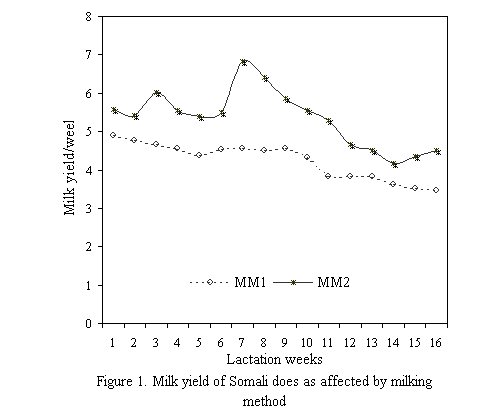
Table 1. Weekly milk production obtained through hand milking (HM) and kid suckling (KS)
|
Week |
MM1 |
MM2 |
|||||||
|
HM |
KS |
Total |
% HM |
HM |
KS |
Total |
% HM |
||
|
1 |
1.13 |
3.77 |
4.90 |
23.1 |
2.02 |
3.55 |
5.57 |
36.3 |
|
|
2 |
1.00 |
3.76 |
4.76 |
21.0 |
1.84 |
3.58 |
5.42 |
33.9 |
|
|
3 |
0.98 |
3.69 |
4.67 |
21.0 |
2.25 |
3.76 |
6.01 |
37.4 |
|
|
4 |
0.90 |
3.66 |
4.56 |
19.7 |
1.67 |
3.88 |
5.55 |
30.1 |
|
|
5 |
0.85 |
3.52 |
4.37 |
19.5 |
1.75 |
3.64 |
5.39 |
32.5 |
|
|
6 |
0.89 |
3.65 |
4.54 |
19.6 |
1.81 |
3.7 |
5.51 |
32.8 |
|
|
7 |
0.85 |
3.71 |
4.56 |
18.6 |
2.11 |
4.72 |
6.82 |
30.8 |
|
|
8 |
0.82 |
3.68 |
4.50 |
18.2 |
2.16 |
4.24 |
6.40 |
33.8 |
|
|
9 |
0.75 |
3.80 |
4.55 |
16.5 |
1.86 |
4.00 |
5.86 |
31.7 |
|
|
10 |
0.61 |
3.71 |
4.32 |
14.1 |
1.66 |
3.88 |
5.54 |
30.0 |
|
|
11 |
0.48 |
3.36 |
3.84 |
12.5 |
1.54 |
3.76 |
5.30 |
29.1 |
|
|
12 |
0.40 |
3.44 |
3.84 |
10.4 |
1.06 |
3.60 |
4.66 |
22.7 |
|
|
13 |
0.36 |
3.47 |
3.83 |
9.40 |
0.60 |
3.92 |
4.52 |
13.3 |
|
|
14 |
0.36 |
3.27 |
3.63 |
9.90 |
0.33 |
3.84 |
4.17 |
7.9 |
|
|
15 |
0.36 |
3.17 |
3.53 |
10.2 |
0.34 |
4.01 |
4.35 |
7.8 |
|
|
16 |
0.39 |
3.08 |
3.47 |
11.2 |
0.60 |
3.90 |
4.50 |
13.3 |
|
3.3 Weight Development
Preweaning kid weights are shown in Figure 2. The average weaning weight of kids reared by MM1 and MM2 does was 11.3 and 14.2 kg, respectively. Weaning weight of MM2 kids was 27.5% greater than for MM1 kids, presumably because of greater daily milk availability and consumption with MM2.
Throughout the lactation period kids reared under MM2 were heavier than those under MM1. Generally, the effect of milking method on kid weight was cumulative. That is, during early lactation (e.g., first 6 weeks) kid weights were not significantly different. But, weight differences became more pronounced with advancing stage of growth. This finding agrees with that of Ruvuna et al. (1988), in which partial suckling did not affect growth of kids of east African goat breeds up to 4 weeks of age. It appears that in early lactation does produce more milk than required for acceptable kid growth.
Conclusion
Because of the amount of total milk produced by does, weight development of kids and the amount of milk harvested for human consumption, milking method 2 is recommended. This method is also less labor intensive, allowing small-scale goat farmers to harvest milk only once in the morning after an overnight separation and leaving remaining milk for the growing kids. Thus, until further studies are conducted with alternative milking methods, small-scale dairy goat farmers should consider harvesting milk once daily, and leaving remaining milk for kids.
References
Farm Africa, 1996. Dairy Goat Development Program, Addis Ababa, Ethiopia.
Ruvuna performance of goats and growth rates of kids under different milking and rearing methods, F., Cartwright, T.C., Blackburn, H., Okeyo, M. and Chema, S. 1988. Lactation in Kenya. Animal prod. 46; 237-242
SAS, 1992. System for Linear Models, Third Ed. SAS. Institute Inc., Cary, NC, USA.
Citation:
Feyissa, F. and G. Abebe. 2000. Effect of partial suckling on milk yield of Somali does and growth rate of their offspring. In: R.C. Merkel, G. Abebe and A.L. Goetsch (eds.). The Opportunities and Challenges of Enhancing Goat Production in East Africa. Proceedings of a conference held at Debub University, Awassa, Ethiopia from November 10 to 12, 2000. E (Kika) de la Garza Institute for Goat Research, Langston University, Langston, OK pp. 212-216.