
Solomon Desta and Layne Coppock – Department of Rangeland Resources, Utah State University, Logan, Utah, USA
Abstract
Recent increases in human and livestock population, and decreases in availability of grazing lands in the Borana pastoral system of southern Ethiopia, have eroded the effectiveness of traditional means to decrease livestock losses during drought. It was hypothesized that because Borana households appear to be losing an increasing number of cattle in dry years, divesting some portion of their cattle wealth into non-traditional assets and increasing holdings of camels and small ruminants could benefit wealth accumulation, risk mitigation, food security, and environmental protection. The primary objectives of this research were to: (i) determine system trends and find out shifts of emphasis on holdings of different livestock species, particularly camels and goats; (ii) characterise cattle population dynamics; and (iii) estimate economic losses from cattle mortality. A socioeconomic survey was carried out among 336 Borana pastoral households to assess household economics and system trends. Cattle population dynamics for the period 1980 to 1997 were quantified using herd histories obtained from detail group interviews of a subsample of 60 randomly selected households. Data were aggregated across households to portray cattle population trends and quantify economic losses. Results from the socio-economic survey indicated that the Borana perceive that their cattle based pastoral system is becoming less able to support pastoral livelihoods. A large number of households are keeping an increasing number of camels and there is a growing interest to keep more small ruminants. Findings in general confirmed predictions that cattle holdings per household were declining and that herd dynamics were following a “boom and bust” pattern. Droughts in the 1980’s and 1990’s resulted in the deaths of 37 to 42% of all cattle, respectively. Over 17 years the Borana losses in the form of cattle mortality valued about US $300,000,000.
Introduction
African pastoral systems are currently being characterized by decreased stability, food insecurity, decreasing income, increasing poverty, and environmental degradation. Loss of key grazing lands to cultivation, land annexation by government and private interests, drought, inappropriate development policies, population growth, and supposed pastoral “irrationality” in keeping large herds which over-utilize resources have been proposed as causes of these trends (Sandford, 1983; Moris, 1988; McCabe, 1990; Galaty and Bonte, 1991; Bonfiglioli, 1992; UNSO/UNDP, 1994).
Traditional subsistence pastoralism operated very successfully in the rangelands of eastern Africa for thousands of years. Pastoralists and their livestock were in dynamic equilibrium with the rangeland environment (Herlocker, 1999). The pastoral areas in Ethiopia are one of the most drought-vulnerable, with chronic food deficiencies (Federal Democratic Republic of Ethiopia, 1996). The Borana pastoral system of southern Ethiopia traditionally has been based on cattle husbandry for wealth storage and milk production, and on small ruminants for quick cash income. It has apparently functioned very well for hundreds of years to mitigate risks inherent in pastoral production systems and to support pastoral livelihood in a harsh semiarid and arid environment (Pratt 1987; Cossins and Upton 1987, 1988a; Helland 1997). However, similar to other African pastoral systems, the Borana system has recently shown symptoms of destabilization. In particular, recent increases in human and livestock populations, decreases in availability of grazing lands, and a decline in adherence to social mores have eroded the effectiveness of traditional means to stem risks of livestock asset losses during drought (Coppock,1994; Helland,1997). Between 1980-1 and 1998-2000 the pastoral areas of Ethiopia suffered 3 major droughts. In the 1983-5 and 1990-2 droughts, the Borana pastoralists lost 35 to 42% of their livestock inventory (Desta et al., 1986; Coppock, 1994). In the 1998-2000 drought, Borana pastoralists lost 67% of their cattle wealth (Shibru, 2000). Tens of thousands of Borana pastoralists remained dependent on permanent food relief by 1999-2000 (Shibru, 2000, Solomon Desta personal observations). It was observed that the Borana appeared to be having an increased risk of losing large numbers of cattle to drought (Coppock, 1994). Women were selling dairy products from milk-deficit situations (Holden and Coppock, 1992), and land was being annexed from communal use for cultivation and forage reserves by local individuals and communities (Atsedu, 1990). Grazing lands were becoming degraded as a result of bush encroachment and soil erosion and interest in goats, sheep, and camel production was increasing (Coppock, 1994).
The overall objective of the study was to use the Borana pastoral system as a case study to determine:
1. the functioning and current socio-economic trends for the Borana pastoral system. The systemic changes predicted in Coppock (1994) for Borana pastoralism were:
(i) increasing poverty and food insecurity;
(ii) increasing cultivation;
(iii) increasing wealth stratification;
(iv) increasing annexation of higher potential land for forage reserves to serve calves and less mobile livestock;
(v) increasing small ruminant and camel production;
(vi) increasing off-take of cattle to buy grain;
(vii) decreasing milk yield;
(viii) increasing risk of famine;
(ix) decreasing percentage of mature males and increasing percentage of cows in the regional cattle herd;
(x) increasing soil erosion and range degradation; and
(xi) increasing dependence on market transactions.
2. how cattle holdings had changed over the period 1980-97 and estimate economic losses attributable to cattle mortality. Results would give insights into system changes, trends on small ruminant and camel production, and long-term dynamics for the cattle population and would provide information for designing natural resource and risk management interventions.
Material and Methods
Study Area
Research was conducted in the southern Ethiopian rangelands among Borana pastoralists. The human population in the region including the Borana, Somali, Gabra, and other minorities is about 410,000 (CSA 1996a). The dominant ethnic group is the Borana, numbering around 325,000, and herding some one million head of cattle along with a few sheep, goats, camels and equines (Desta, 1988; CSA, 1996; Helland, 1997). Research was implemented using four towns in the north-central portion of the southern rangelands as focal sites for sampling. These towns were Arero, Mega, Negelle, and Yabello.
The climate in the southern Ethiopian rangelands is generally semiarid with annual rainfall averaging 500 mm in the south to 700 mm in the north (Billé and Eshete, 1983). Delivery of rainfall is bimodal (Coppock, 1994). Elevation ranges from 1,000 m in the south to 1,500 m in the northwest. The study area is dominated by savanna vegetation containing mixtures of perennial herbaceous and woody vegetation (AGROTEC 1974, Coppock 1994). Savanna communities vary from open grassland to bush-encroached areas. Savannah systems are known for variation in their proportion of woody and herbaceous material as well as the marked shifts in composition that occur in response to heavy grazing, browsing, burning, and drought, either alone or in various combinations (Pratt and Gwynne 1977). In some cases grazing shifts the community toward more trees available for browsing, whereas fire favors grasses.
The dominant herbaceous species in the study area are perennials such as Pennisetum, Themeda, Panicum, Cenchrus, Cynodon, and Chrysopogon spp. Bush encroachment is a serious problem in the wetter part of the region (unpublished report, SORDU; Coppock, 1994). The major invading woody species include Commiphora spp., Acacia brevispica, A. drepanolobium, A. seyal, A. bussei, A. nubica, A. nilotica, A. reficiens, and A. mellifera (Coppock, 1994). The study area is also home for other highly nutritive and economically important woody vegetation, including A. tortilis and A. senegal (Coppock, 1994).
The Borana plateau is a water-limited environment. The major sources of water for both humans and livestock in the Borana plateau are wells and ponds. The Borana are Oromo people who speak Oromifa. The Oromifa language is of Cushitic origin. The clans, high priest (kallu), and gada system are the mainstays of a highly organized and durable social structure of the Borana (Legesse, 1973; Hogg, 1992, 1996; Helland, 1997). The basic unit of Borana social structure is the household. A Borana household is defined as a man, his wife, their children and those who are food-dependent on the household livestock and other resources (Tilahun, 1984; Hogg, 1992). The Borana generally split their herds into two groups commonly called the forra and warra herds. The forra herd is basically the dry animals while the warra herd constitutes the milking cows, calves, immature cows (< 2 years old), and small ruminants (Coppock, 1994; Desta, 1999). For most of the year warra herds graze close to the olla (encampments) and forra herds graze farther away where resources are more plentiful. Study Site Selection
The target population for this study was comprised of about 7,000 pastoral households residing within a 35-km radius of the towns of Arero, Mega, Negele, and Yabello during 1996-7. The cumulative 15,500-km2 sampled area represented 16% of the plateau in terms of size and contained about 15% of the total pastoral population (CSA, 1996; Desta, 1999). These four town-based sampling areas are henceforth referred to as study sites.
Study sites varied with respect to rainfall and natural resource management. The Negele and Arero sites have higher rainfall compared with Yabello and Mega. Natural resource use is also less controlled in Negele and Arero compared with that for Yabello and Mega (Desta, 1999). The traditional forms of grazing control based on access to water in the permanent deep-well system prevailed around Yabello and Mega.
Sampling
The sample unit was the household consisting of people dependent upon family-owned livestock for their sustenance. A sampling frame was created by listing all pastoral households in the four study sites. Key informants were then used to stratify households by wealth class based on modal ratios of cattle per person (Grandin, 1988; Assefa, 1990). Modal ratios ranged from about 14:1, 6:1, and 2:1 for wealthy, middle class, and poor households, respectively (Desta, 1999). A final sample of 336 households, or 4.7% of the target population, was selected for the broad survey. Each study site had 84 households, but wealth classes were sampled proportionally to their occurrence. Wealthy, middle class, and poor households in the sample totaled 24, 124, and 188, respectively. This reflected that 7, 37, and 56% of households were wealthy, middle class, or poor in the sampling frame (Desta, 1999). A sub-sample of 60 households was used for the detail analysis of cattle herd dynamics. Households were blocked according to study site with 15 each. Households were stratified according to wealth class with 5 per wealth class per site. The sampling design was thus stratified random.
Data collection and analysis
Results reported here were obtained using two surveys implemented over a period of about 18 months. One survey was broader in terms of data collection—this was to involve the 336 households. The other survey was narrowly focused with more detail and required follow-up visits with a sub-sample of 60 households. Both surveys typically relied on group interviews of extended families.
The objective of the broader survey was to get a picture of how the people perceived the state of their production system and lives at the present time. It was also intended to find out if there is a shift of emphasis on livestock species holdings towards camel and small ruminants. This survey took two to three hours to complete for each household.
The main objective of the detailed survey was to quantify how cattle holdings had changed over the period 1980-97. We expected a declining trend for cattle holdings per household and a cycle of growth in numbers followed by sharp drops due to rainfall deficits–essentially a “boom and bust” cycle. These interviews took up to two days to complete for each household. Families were asked to form consensus and recall herd histories going from 1997 backwards in a stepwise fashion to 1980. The 17-year period was needed to have a sufficient time to capture droughts in 1984-5 and the early 1990’s. The Borana traditional calendar (Legesse, 1973) was used along with known benchmark years for droughts and other ecological, social, political, and cultural phenomena. Annual estimates of the annual herd size, mortality rates, birth rates, local stocking rates, rainfall level, purchases, sales, and other forms of animal acquisition were obtained as general estimates. Such approaches have been shown to be effective with African pastoralists because they place a very high cultural value on livestock and have well-developed mental skills to track cattle inventories (Assefa, 1990; Ensminger, 1992).
Data were typically analyzed using descriptive statistics such as 95% confidence intervals (CI). This was employed to contrast household resources in 1996 to 1997 with previous findings of Desta (1988), Assefa (1990), and Coppock (1994). Pearson’s chi square was used to assess effects of wealth class and formal education on economic diversification of households. A person was considered as having received formal education if s/he attended school through at least the second grade (Desta, 1999).
The cattle population dynamics compiled across all 56 households and the magnitude of mortality and net sales over the period were documented. The value of cattle mortality losses were estimated using available market price data from SORDU and CARE Borana.
Results
For both surveys about 95% of designated households participated. Out of 7,007 households comprising the target population, over half were in the poor economic class (Table 1). About 13% of household heads were female, while over eight in 10 female household heads were categorized as poor (Table 1).
Table 2 illustrates comparisons among population data for cattle and people collected in 1996-7 with that of previous studies. Patterns indicate that the number of people per household has increased in the last decade while the number of cattle per person has decreased overall, mostly as a result of declines in herd size among the wealthy. A smaller percentage of households were reportedly wealthy in 1996-7 compared with that for 1988. One outcome of a decline in cattle numbers per capita is decreasing wealth. Data in Table 3 indicate that most respondents perceived they were becoming poorer. Almost 50% of households reported a decline in wealth status in recent times, while only 7% reported an increase.
Table 1. Target population for four study sites on the north-central Borana Plateau as distinguished according to wealth class and gender*
|
Wealth Class |
||||
|
Gender |
Wealthy |
Middle Class |
Poor |
Total |
|
Male |
495 |
2,460 |
3,151 |
6,106 |
|
Female |
15 |
145 |
741 |
901 |
|
Total |
510 |
2,605 |
3,892 |
7,007 |
*Where wealth class was based on the ratio of cattle:people in each household. Wealthy, middle class, and poor households had cattle:people ratios of 14:1, 6:1, and 2:1, respectively (Desta, 1999).
Table 2. Population data for cattle and people from the north-central Borana Plateau*
|
Time Period |
|||
|
Parameter |
1996-7 |
Previous |
Reference |
|
|
|
|
|
|
Persons per household |
7.4 +/- 0.3 |
5.5 +/- 0.4 |
Assefa (1990) |
|
Cattle per household |
34 +/- 10 |
34 +/- 14 |
Assefa (1990) |
|
Cattle per person |
5.0:1 |
6.2:1 |
Assefa (1990) |
|
Cattle |
|||
|
Female:male |
71:29 |
71:29 |
Coppock (1994) |
|
Mature cows (%) |
38 |
45 |
Desta (1988) |
|
Households |
|||
|
Wealthy (%) |
7 |
18 |
Assefa (1990) |
|
Middle class (%) |
37 |
31 |
Assefa (1990) |
|
Poor (%) |
56 |
51 |
Assefa (1990) |
*Statistics include 95% confidence intervals. Data from Assefa (1990) were collected in 1988 and were based on n = 633 pastoral households. Data from our study in 1996-7 were based on n = 317 pastoral households. All households were in the north-central region of the Borana Plateau. Statistics denoted for “All” were based on weighted averages that incorporated the proportion of various wealth classes in each population over time. Data for herd composition in Desta (1988) were based on a regional census.
Table 3. Recent shifts in wealth status as reported by 317 Borana households*
|
Past Wealth |
||||
|
Current |
n |
Wealthy |
Middle Class |
Poor |
|
Wealthy |
24 |
22 |
1 |
1 |
|
Middle |
132 |
56 |
58 |
18 |
|
Poor |
161 |
29 |
73 |
59 |
*Where wealthy households had a ratio of cattle to people of around 13:1, middle class households had a ratio of around 6:1, and poor households had a ratio of around 2:1 (Desta, 1999). Shift in wealth status was with regards to the past 5 to 10 years.
Perceptions of system trends among herd owners are shown in Table 4. The overall view strongly supported the idea that availability of grazing land had declined as had quantity of milk for people and calves. Standard of living reportedly had dropped for most households. The vast majority of herd owners perceived that the need for pastoralists to sell dairy products had increased, growth in the size of the human population had occurred, the need for cash income had increased, and that there was a heightened availability and demand for grain for human consumption. Opinions regarding trends for livestock species were mixed. Production of small ruminants was generally thought to be in decline, while camel holdings were noted to be increasing (Table 4). Despite periodic decimation of the regional cattle herd due to drought (Figure 1), the perceived trend was that the size of the regional cattle herd had increased over the longer term, and improvements in cattle health from veterinary interventions was a primary reason for this pattern (Desta, 1999).
Table 4. Trends in the Borana pastoral system as perceived by 317 herd owners*
|
Perceived Trend (% Who Agree) |
|||
|
Feature |
Decreasing |
Increasing |
No Change |
|
Cattle production |
24 |
74 |
2 |
|
Sheep production |
74 |
24 |
2 |
|
Goat production |
59 |
38 |
3 |
|
Camel production |
14 |
84 |
2 |
|
Access to grazing |
91 |
7 |
2 |
|
Milk for people |
97 |
1 |
2 |
|
Milk for calves |
97 |
1 |
2 |
|
Standard of living |
55 |
11 |
32 |
|
Grain in markets |
22 |
76 |
0 |
|
Pastoral grain |
1 |
99 |
0 |
|
Pastoral dairy |
29 |
71 |
0 |
|
Human population |
0 |
98 |
0 |
|
Need for cash |
0 |
99 |
1 |
*Some rows may not add to 100%, and this is due to some respondents having “no opinion.
** Seventy-five percent of respondents felt that a gradual privatization of key lands due to creation of fodder reserves and cultivation, and increasing restrictions in access to the deep wells for poorer households, was reducing mobility of livestock herds (Desta, 1999).
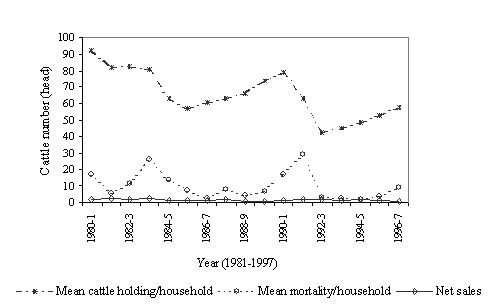
Figure 1. General cattle dynamics, mortality and netsales for the Borana cattle system.
We estimated the total livestock inventory for Borana in 1996-7 by taking our household statistics for numbers of people and animals and scaling-up relative to the total pastoral population of 325,000 as estimated by Helland (1997) from data in CSA (1996). Results are shown in Table 5. Cattle clearly dominated the inventory.
Ranked income sources for 56 households are shown in Table 6. Livestock, as the traditional source of income remained dominant, although non-traditional agricultural activities such as sales of dairy products and grain were also commonly mentioned. Small ruminants constitute a significant portion of income from livestock sales for the poor and the middle class households. Domestic markets are much more available for goats compared with other species (Coppock, 1994). Camels and goats fetch better prices during drought time in Borana plateau and their condition does not deteriorate too quickly and are more tolerant to stress conditions compared with cattle (Desta, 2000a). Non-pastoral or non-agricultural income sources were rare and dominated by mining and wage labor. In general economic links of pastoralists to town-based economies were very limited.
The most common form of diversification away from traditional livestock production involved cultivation. We found that 67% of 311 households were routinely cultivating with significant variation among study sites in the percentage of households cultivating (Desta, 1999). Pearson’s chi square test revealed that a higher proportion (74%) of wealthy and middle-class households was cultivating compared with 61% of poorer households (P<0.05, X2 = 5.9, df = 2). The average plot size (+/- SE) per household was 1.8 +/- 0.2 hectares (Desta, 1999). Less than 1% of the Borana Plateau was estimated to be under cultivation by 1997, and this may translate to around 5% of potentially arable land (Coppock, 1994; Desta, 1999). Only 57 of 317 households (18%) had members with any formal education. The rate of illiteracy per capita was 92%. Households with members having formal education were positively associated with economic diversification outside of traditional livestock production (P<0.01, X2 = 7.7, df = 1). The association was stronger, however, for economic diversification beyond livestock and crop production (P<0.001, X2 = 5.8, df = 1). Table 5. Livestock inventory for the north-central Borana Plateau in 1996-7 as derived by aggregating interview data from 317 pastoral households and extrapolated to expected holdings for a pastoral population of 325,000*
|
Species |
Number |
Percent |
|
Cattle |
1,440, 470 |
73.2 |
|
Goats |
288,762 |
14.7 |
|
Sheep |
127,395 |
6.5 |
|
Camels |
75,588 |
3.8 |
|
Donkeys |
25,479 |
1.3 |
|
Other equines |
9,767 |
0.5 |
|
Total |
1,967,461 |
100.0 |
*The estimated pastoral population of 325,000 is from Helland (1997) based on data in CSA (1996).
Table 6. Ranked sources of income for 56 pastoral households on the north-central Borana Plateau, 1996-7
|
Income Source* |
|||||||
|
Rank |
Livestock |
Dairy |
Wages |
Grain |
Gold |
Salt |
Other |
|
1 |
43 |
0 |
2 |
2 |
1 |
1 |
5 |
|
2 |
4 |
13 |
1 |
5 |
6 |
3 |
4 |
|
3 |
3 |
4 |
3 |
6 |
1 |
2 |
0 |
|
4 |
0 |
7 |
1 |
2 |
0 |
0 |
0 |
*Where “grain” implies home-grown cereals (largely maize) that were sold. Gold was typically mined from sites to the north, while salt was mined from volcanic craters to the south. “Other” income sources included cattle trading, gum arabic collection, small-scale entrepreneurial activities in towns, etc. (Desta, 1999).
Cattle population dynamics compiled across all 56 households are shown in Figure 1. Two things are apparent, namely a long-term decline in cattle holdings and an oscillating boom and bust pattern. Cattle holdings fell from an average of 92 to 58 head/houshold in 1980 and 1997, respectively, a net drop of 37%. The boom and bust illustrates drought-related declines in inventory reportedly due to mortality, not marketed off-take. Death losses were 10 to 15 times higher than net sales (Figure 1). The cattle population dynamics is regulated mainly by mortality. The net loss of cattle from drought in the early 1980s was 34 head/household or a decline of 37%. The average household herd recovered to 85% of pre-drought levels by the time it reached a subsequent peak in 1990. The next loss of cattle from drought in the early 1990s was 33 head/household or a decline of 42%. This level of herd loss in the early 1990s was similar to that from the 1980s. Matching cattle losses with prices in terms of sex and age class, and considering a target population of 7000 households with 7.3 persons per household, this translated into an average economic loss of 710,622 head valued at about USD 45.7 million.
Discussion and Conclusions
Results confirmed the predictions in Coppock (1994) that the Borana system appears to be becoming more unstable and less reliable to support livelihoods. Our household-level data lead us to speculate that declines in food security and wealth among the Boran appear more attributable to an increase in the human population rather than an absolute drop in cattle numbers per se. Views of the Borana leadership at the 37th Gumii Gaayo also support the perception of respondents to our survey that the cattle population has increased.
Research by B. Lindtjorn (Univ. Bergen, unpublished data) in the late 1980s estimated the rate of growth for the pastoral population to be 2.5% per annum, while the CSA (1996) used a growth rate of 2.2 % per annum in their population projections. We see lack of out-migration as the main problem spurring growth in pastoral populations in southern Ethiopia, and this is most likely due to underdevelopment of other economic sectors (Coppock, 1994).
& Besides human population growth, the next most important factor contributing to reduced productivity and heightened food insecurity here may indeed be environmental degradation. The Boran reportedly have been increasingly hemmed-in by other ethnic groups at their territorial margins in recent years. The Boran have lost northern territory to the Guji (Huqqaa, n.d.; Desta, 1999). This has led to a greater concentration of livestock in the central Borana Plateau. This external stress has created more internal pressure as satellite (forra) herds increasingly trespass on grazing areas (arda) reserved for home-based (warra) herds according to reports from respondents in Desta (1999). The resulting overgrazing has, in turn, contributed to bush encroachment with detrimental effects on production of herbaceous forage. Local regulation of resource use is also being compromised. This has primarily occurred as a recent, state-level administration has usurped traditional authority in many cases (Huqqaa, n.d.; Desta, 1999; Moris, 1999).
Cultivation started to become widespread on the central Borana Plateau after the 1983-4 drought as people opportunistically planted maize and cowpea (Vigna sp.) to deal with food gaps created by massive cattle mortality. As recently as the 1960s few pastoral Boran regularly cultivated (Legesse, 1973). Cultivation helps diversify sources of food and income for pastoralists during some non-drought years, as roughly three of five non-drought years are anticipated to have sufficient rainfall to produce a crop (Desta, 1999). Cultivation has mixed attributes with regards to augmenting drought coping strategies. On one hand, cultivation can undermine drought coping strategies because cultivated area usurps key grazing areas and, of course, yields little or no food when rainfall is low.
Annexation of communal grazing land for cultivation and calf forage reserves by local communities and individuals began in earnest on the central Borana Plateau during the 1980s, although it was initiated on a small scale some 20 years previously (Atsedu, 1990; Coppock, 1994). Land annexation is a common response to chronic grazing pressure and heightened uncertainty of resource access (see review in Coppock, 1994). Our work indicated that by the late 1990s land annexation for grazing and farming and restrictions in access to deep wells were all seen as threats by a majority of survey respondents. Again, the greatest fear was how such controls could limit herd mobility during times of stress (Desta, 1999). Ensminger (1990) noted similar trends among Orma pastoralists in Kenya. Population pressure, shrinkage of resources, and lack of opportunity for territorial expansion forced the Orma to restructure property rights in favor of privatization.
Our only firm evidence of a shift in livestock species composition was in terms of camels—our estimate of 75,000 head of camels for 1996-7 is considerably higher than the 15,000 head recorded as held by the Boran in 1987 (Desta, 1988). We believe these data reflect a purposeful strategy by many Boran to incorporate more camels to diversify their holdings of large livestock. This shift is likely in response to woody encroachment that benefits browsing camels over cattle, and contributions that camels make to increased milk production for home consumption and sale during drought–camels are also useful for hauling grain and water far from settlements (Coppock, 1994). Small ruminants are not considered a store of wealth as are cattle, but they are very important for households to meet routine cash income needs. Recently it has been observed a growing interest among Borana to keep more small ruminants (Desta, 1999, 2000b). Similar trends were observed in north Kenya where pastoralists disinvest in cattle in favour of small ruminants and camels. Despite high level of risk due to endemic caprine diseases (personal communications, Drs. Tafesse Mesfin and Abakano Kereyu, TLDP), survey respondents expressed an increasing interest to raise more small ruminants, as predicted in Coppock (1994). Goats were marketed at a higher price in all markets in the plateau during the last drought and provide some households with cash income to survive the stressful situation (Desta, 2000b). Development organizations working in Borana are currently distributing camels and goats to restock households who lost their herd to the recent drought (personal communication, Ato Solomon, Manager, Action for Development). Small ruminant production and trading was observed to be an important economic activity by women groups in north Kenya (Desta, 2000b). Some of the women groups used the proceeds from the small ruminant production and trading business to establish a successful savings and credit services, to provide various social services to members, and to diversify their economic activities to non-pastoral investment sector including real estate and hotels. Such groups claimed that they were able to cope better with the impacts of the droughts that hit the region at various times (Desta, 2000b).
The growing interest in camel keeping and small ruminant production can be explained as components of an emerging strategy to achieve food security. The small ruminant production may also help to avoid or at least minimize the need to sell cattle, which is considered the most important means of wealth storage for Borana (Coppock 1992). Moreover, the ability of camels to utilise woody vegetation for forage is reflected in the growing number of camels in the semiarid rangelands of southern Ethiopia and northern Kenya (Herlocker, 1992, Coppock 1994). Sheep and goats are also more tolerant to arid environments than cattle.
Half (50%) of Borana households reported that they have experienced a major downward shift in wealth class in recent years. A very small percentage (6%) of sample households made an upward movement (Table 6). The remaining 44%, which mainly include poor and middle-class households, have remained in the same wealth class. There is a growing trend of wealth class polarization among the Borana. According to most respondents, a major downward shift in wealth class occurred in 1968-74 due to a severe drought. Added impact occurred from droughts in 1983-5 and 1990-2. The Borana perceive that their cattle-based pastoral production system is facing a serious long-term problem. The emerging situation is forcing the Borana to include more camels and small ruminants in the herd structure. Coppock (1994), Hogg (1996), and Helland (1997) detected a similar situation among the Borana pastoralists.
A convincing increase has not been documented in the percentage of pastoral households regarded as “poor” despite prevailing views that the standard of living and level of wealth was declining in general. The percentage of households noted as poor in the late 1980s was 51%, and this figure was 56% in the present study. We explain this apparent contradiction as a result of sampling bias—namely, our study focused on households that remained viable in the pastoral system and avoided those clustered around towns and settlements. The latter are typically comprised of people who have lost too many animals and have thus been ejected from the pastoral system (Holden, Coppock et al., 1991; Coppock, 1994). Had we been able to track this peri-urban sub-population we speculate that the percentage of poor households would have indeed increased in the last decade.
Survey respondents commonly expressed a need for opportunities to diversify their economy given pressures on traditional resources. Hogg (1980) concluded that Boran in northern Kenya who had diversified away from a sole reliance on traditional livestock production were better able to endure drought perturbation. Our results revealed that diversification was most typically expressed in the form of increased involvement in cereal cultivation and camel production and increasing interest in small ruminant husbandry—we surmise that a specter of food insecurity is the primary driver for this pattern. There were few apparent economic links between pastoralists and neighbouring towns, however, such as regular wage labor, involvement in small business, etc. this may be attributable to a generally lower level of economic development in rural Ethiopia and a less-educated pastoral population (Little and Smith, et al., submitted). We found exposure to formal education to be positively associated with non-agrarian economic diversification of households. Degree of formal education has been shown elsewhere to positively influence the success of rural extension programs (Phiri, 1998). In recent political decrees the Boran have voiced support for pursuing more education for male and female youths and noted that the health of their pastoral economy increasingly depends on diversified linkages to towns and settlements (Huqqaa). In summary, the Borana pastoral system in southern Ethiopia is experiencing a downward negative trend. Our observations validate the concept that increasing human population underlies changes in resource use and shifts in proportions of livestock species composition, especially where avenues for alternative economic development are limited.
The cattle population dynamics for the study period exhibited boom and bust characteristics.Considering yet another “drought crisis” in the southern rangelands during 1998-2000 (Shibru, 2000; Desta, personal observation), the pattern since 1980 appears to be a herd crash every 6 to 8 years. Borana herdowners have noted that cattle herds typically grow rapidly after droughts have reduced their numbers. Some stated that at least 5 years is required for cattle numbers to regain a “high density” phase where the population again becomes vulnerable to even minor dips in annual rainfall (Desta, 1999).
Cattle mortality represents a significant economic loss to Borana society. The average annual loss of USD $384 per household is nearly three times the average annual cash income of USD $135 (Coopock, 1994). To illustrate further, if our results are extrapolated to the entire Borana Plateau where drought impacts were equally severe, loss of livestock wealth could exceed USD $300 million for the period 1980 to 1996/7.
Species diversification, herd segregation, and herd dispersal over a wide range of grazing lands and social wealth redistribution networks were the most commonly used mechanisms to spread and mitigate production risks in pastoral systems and to promote smoother income flow (Jahnke, 1982; Galaty and Johnson 1990; Mace, 1990). The effectiveness of these traditional organizations and institutions to manage the pastoral system, however, is weakening as resources are depleted and competition among households intensifies.
The question remains for the Boran and similar societies in the semi-arid zone as to how natural resource and risk management intervention might facilitate positive change when resource pressure becomes chronic, human population population is steadily increasing, and appropriate technology and extension capacity are limited. Increasing availability of browse species in the vegetation cover is favoring production of browsers (camels and goats), but occurrence of caprine and camels diseases limits their production. Moreover, Borana are not good in camel keeping. The environmental implication of expansion of browser husbandry in the Borana plateau requires close attention. We, however, advocate a facilitating approach emphasising self-help for communities, households, and individuals to better manage risk through economic diversification, a spontaneous trend observed throughout pastoral societies in east Africa (Little and Smith, et al., submitted). Lack of alternatives to the pastoral livestock economy has thus trapped these societies in a vicious downward cycle of poverty. One intervention strategy may include creating alternative and complementary investment options to livestock that help create a virtuous cycle that conserves wealth and ultimately provides capital to diversify local economies. Capturing simply a fraction of the asset losses documented here would be a useful start. The foundation for such an approach includes creation of viable capacities for rural finance and improved marketing (Desta et al., 1999). Small ruminant production and trading may play a vital role to initiate a saving and investment tradition among pastoral households that may lead to a broader economic diversification to the non-pastoral sector as observed among women groups in north Kenya.
Acknowledgments
Financial support for this work was provided by Utah State University (USU), the Rockefeller Foundations, the International Livestock Research Institute (ILRI), and the Small Ruminant/Global Livestock Collaborative Research Support Program of the United States Agency for International Development (USAID) under the terms of grants no. DAN-1382-G-00-0046-00 and no. PCE-G-00036-00.
Susan Durham (USU) and Ato Zerihun Tadesse (ILRI) are acknowledge for assistance with statistics and sampling, respectively. Dr. Simeon Ehui and other staff at ILRI are thanked for their guidance and support, Mulugeta Shibru, Seyoum Tezera, Godana Wario, and Mohammed Ibrahim assisted with field data collection.
References
AGROTEC/CRG/SEDES Associates, 1974. Southern rangelands livestock development project. Part II. Studies and surveys, volume I: Range ecology. AGROTEC/CRG/SEDES Associates/Imperial Ethiopian Government Livestock and Meat Board, Rome, Italy.
Assefa, M., 1990. Borana Cattle Herds: Productivity, Constraints, and Possible Interventions. MSc thesis. Colorado State University, Fort Collins. 154 pp.
Atsedu, M., 1990. Ecology of Calf Pastures and Supplementary Feeding by Borana Pastoralists of Southern Ethiopia. MSc thesis. Colorado State University, Fort Collins. 117 pp.
Billé, J. C. and A. Eshete., 1983. The ecology of Sarite and Dembala Wacho cooperative ranches. JEPSS (Joint Ethiopian Pastoral Systems Study) Research Report 7. International Livestock Center for Africa, Addis Ababa, Ethiopia.
Bonfigilioli, A. M., 1992. Pastoralism at a Crossroads: Survival and Development Issues in African Pastoralism. Project for Nomadic Pastoralists in Africa. UNICEF/UNESCO, Nairobi, Kenya.
Coppock, D. L., 1994. The Borana Plateau of southern Ethiopia: synthesis of pastoral research, development and change, 1980-91. Systems Study No. 5. Addis Ababa: International Livestock Centre for Africa. 374 pp.
Cossins, N. & Upton, M., 1987. The Borana pastoral system of southern Ethiopia. Agricultural Systems 25: 199-218.
CSA (Central Statistical Authority)., 1996. The 1994 Population and Housing Census of Ethiopia: Results for Oromiya Region. Vol. I, Part I: Statistical Report on Population Size and Characteristics. Addis Ababa: Central Statistical Authority.
Desta, S., W. Ayele, E. Biru, G. Fida, and S. Tezera., 1986. Report on effects of deficient long and short rains in 1983 in Borana and Arero Awrajas. Unpublished report. SORDU (Southern Rangelands Development Unit), Yabello, Ethiopia.
Desta, S., 1988. Southern rangelands of Ethiopia: report on livestock census conducted 13 February to 17 March, 1987. Unpublished report. Addis Ababa: Southern Rangelands Development Unit (SORDU), Third Livestock Development Project (TLDP).
Desta, S., 1999. Diversification of Livestock Assets for Risk Management in the Borana Pastoral System of Southern Ethiopia. PhD dissertation. Utah State University, Logan. 189 pp.
Desta, S., 2000a. GL-CRSP Pastoral Risk Management: outreach/Action research report 1, February , 2000. Unpublished report. Nairobi.
Desta, S., 2000b. GL-CRSP Pastoral Risk Management: outreach/Action research report 2, August, 2000. Unpublished report. Nairobi.
Ensminger, J., 1990. Co-opting the elders: the political economy of state incorporation in Africa. American Anthropologist 92: 662-675.
Ensminger, J., 1992. Making a Market: The Institutional Transformation of an African Society. Cambridge University Press, Cambridge, UK.
Federal Democratic Republic of Ethiopia., 1996. Food security strategy: Paper prepared for the consultative group meeting of December 10-12, 1996. Unpublished report. Addis Ababa, Ethiopia.
Galaty, G & D. J. J., 1990. The World of Pastoralism: Herding Systems in Comparative Perspective. The Guilford Press, New York, N. Y. Belhaven Press. London England.
Galaty, G. & Bonte P., 1991. Herders, Warriors and Traders: Pastoralism in Africa. Africa Modernisation and Development Series, Westview Press, Boulder, Colo.
Grandin, B., 1988. Wealth and pastoral dairy production: A case study from Maasailand. Human Ecology 16: 1-21.
Helland, J., 1997. Development issues and challenges for the future in Borana. Unpublished report. Addis Ababa: Norwegian Church Aid.
Herlocker, D., 1999. Rangeland Resources in Eastern Africa: Their Ecology and Development. GTZ, German Technical Cooperation, Nairobi.
Hogg, R.S., 1980. Pastoralism and impoverishment: The case of the Isiolo Boran of northern Kenya. Disasters 4: 299-310.
Hogg, R., 1992. Cooperative development in the southern rangelands: Past experience and future development. Final consultancy report. Pilot project. FLDP (Fourth Livestock Development Project), Addis Ababa, Ethiopia.
Hogg, R., 1996. Government policy and pastoralism: Some critical issues, p. 22-23. In: S. Edwards and T. Mesfin (eds.). Proceedings of The Conference on Pastoralism in Ethiopia. Addis Ababa University Press, Addis Ababa, Ethiopia.
Holden, S.J., Coppock, D.L. & Assefa, M., 1991. Pastoral dairy marketing and household wealth interactions and their implications for calves and humans in Ethiopia. Human Ecology 19(1): 35-59.
Huqqaa, G., (n.d.). The 37th Gumii Gaayo Assembly. Gada: The Oromo Traditional, Economic and Socio-political System. Addis Ababa: Norwegian Church Aid. 68 pp.
Jahnke, H. E., 1982. Livestock Production Systems and Livestock Development in Tropical Africa. Kiel: Kieler Wissenschaftsverlag Vauk. 253 pp.
Legesse, A., 1973. Gada: Three Approaches to the Study of African Society. New York: The Free Press. 340 pp.
Little, P.D., 1985. Absentee herd owners and part-time pastoralists: the political economy of resource use in northern Kenya. Human Ecology 13(2): 131-151.
Little, P.D., Smith, K., Cellarius, B. & Coppock, D.L., (submitted). Avoiding disaster: Diversification and risk management among east African herders. Development and Change.
Moris, J., 1999. Under three flags: the policy environment for pastoralists in Ethiopia and Kenya. Unpublished SR/GL-CRSP Pastoral Risk Management Project Technical Report No. 04/99. Logan: Utah State University. 119 pp.
Ndofor, A., 1998. Evaluation of the potential for successful, grass-roots credit union development in the southern Ethiopian rangelands. Unpublished SR/GL-CRSP Pastoral Risk Management Project Technical Report no. 01/99. Utah State University, Logan. 25 pp.
Phiri, P., 1998. The Role of Human Capital in Increasing Small Holder Dairy Productivity in Kasungu Agricultural Development Division Milk Shed Area, Malawi. MSc thesis. Utah State University, Logan.
Pratt, D. J., 1987. Status Report on Rangelands and Range Development in Sidamo and Harerge Provinces of Ethiopia: Draft Main Report, FAO Project TCP/ETH/4535. Food and Agriculture Organization of the United Nations, Rome, Italy.
Sandford, S., 1983. Management of Pastoral Development in the Third World. John Wiley and Sons, New York, N.Y., USA/Overseas Development Institute, London, England.
Shibru, M., 2000. Report on effects of deficient long and short rains in 1999/2000 in Borana. Unpublished report. CARE Borana, Yabello.
Tilahun, N., 1984. Household economics study in Borana. Joint Ethiopian Pastoral Systems Study Research Report. International Livestock Center for Africa, Addis Ababa, Ethiopia.
UNSO/UNDP., 1994. Pastoral Development in Africa. First Technical Consultation of Donor and International Development Agencies. Final Report. UNSO, New York, N. Y.
Citation:
Desta, S. and L. Coppock. 2000. Pastoral system trends and small ruminant production in the Borana Plateau of Southern Ethiopia. In: R.C. Merkel, G. Abebe and A.L. Goetsch (eds.). The Opportunities and Challenges of Enhancing Goat Production in East Africa. Proceedings of a conference held at Debub University, Awassa, Ethiopia from November 10 to 12, 2000. E (Kika) de la Garza Institute for Goat Research, Langston University, Langston, OK pp. 29-42.