
1 Alemaya University, Department of Animal Sciences, P.O. Box 138, Dire Dawa, Ethiopia
2 Edinburgh University, Centre for Tropical Veterinary Medicine, Easter Bush, Midlothian, EH25 9RG, Scotland U.K
Abstract
A vaccination trial was conducted using an inactivated preparation of Cowdria isolate (Welgevonden stock) in 12 Siberian x Scottish Goats. The antibodies developed were demonstrated in indirect ELISA. Challenge of goats with virulent Welgevonden stock of Cowdria ruminantium resulted in survival of five out of six goats, indicating that the immunization procedure was protective. Challenge of six control goats resulted in acute infection and death of all animals. The difference observed between immunized and control goats was significant (P < 0.05). Therefore, further study on the potential of inactivated preparation as a vaccine for field use is highly recommended.
Introduction
Heartwater is an infectious non-contagious disease affecting domestic and wild ruminants, transmitted by the ticks of the genus Amblyomma. The agent responsible is considered to be the rickettsia Cowdria ruminantium (Cowdry, 1925). The disease is described throughout Africa especially south of the Sahara, and the distribution coincides with the vector ticks of the genus Amblyomma (Uilenberg, 1983). There is no effective method of vaccination for field use to reduce mortality and morbidity of ruminants. The lack of an effective method for in vitro cultivation of Cowdria has limited research on the tick-borne rickettsial pathogen Cowdria ruminantium.
The objective of the present work was to investigate the immunogienic ability of the inactivated preparations of elementary bodies of Cowdria isolate (Welgevonden stock) cultured in Bovine Aortic Endothelial (BAE) cell culture.
Materials and Methods
Extracellular elementary bodies were harvested from the supernate of Cowdria Welgevonden stock grown in vitro in BAE cell culture when at a maximum level. The elementary bodies were purified following a standard method developed at the Centre for Tropical Veterinary Medicine, Edinburgh University. Then it was inactivated with 0.15% formaldehyde solution, incubated at 37oC for 60 minutes and agitated at every 10 minutes during the incubation. Finally the pellet was resuspended in 15 ml of PBS and well mixed with pipette. The inactivated elementary bodies and soluble antigen were mixed with adjuvant by double-hubbed method (Herbert, 1979).
Twelve Siberian x Scottish goats free of infection were used for this study. These goats are highly susceptible to Welgevonden stock of heartwater (Awa, 1991). Goats were randomly divided into two experimental groups each with six goats. The first group of goats was injected intramuscularly with 1 ml of inactivated elementary bodies’ preparation in Freund’s complete adjuvant (FCA). After 21 days these goats were inoculated with 1 ml PBS subcutaneously. The second group of control goats was inoculated with 1 ml FCA on the first day intramuscularly and with saline at day 21 subcutaneously.
All the goats were examined daily for evidence of clinical reactions. Rectal temperature was also recorded daily. Blood from the jugular vein was collected once weekly for serology and stored at -20oC. Post-immunization sera from goats were screened for Cowdria specific antibody by indirect ELISA. Three goats were randomly selected from each group and challenged at day 36 with Welgevonden stock blood stabilate diluted 1:2 via the jugular vein at a dose rate of 1.5 ml. Clinical reactions were monitored. For all goats that died, post-mortem examinations were conducted and a brain squash smear was prepared, stained with gimesa and examined. The efficacy of the immunization procedure compared with the control was tested by Fisher’s exact test.
Results and Discussion
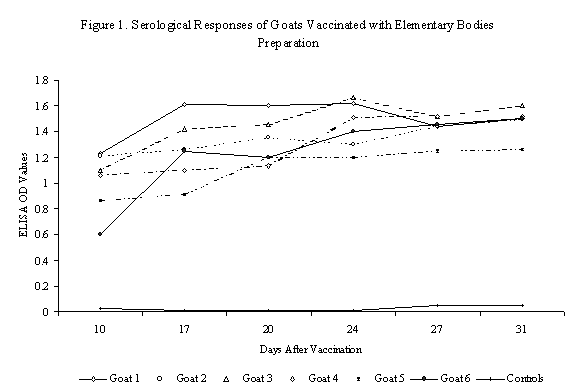
Antibodies appeared somewhat earlier in vaccinated than control goats (Figure 1). The ELISA OD values of serum of two goats increased up to day 17 and thereafter OD values were stable at each sampling date up to day 31 post-inoculation. In the other two goats ELISA OD values peaked at day 24 and remained highest in the group throughout the rest of the sampling period. The remaining two animals showed a slower rise in OD. However, differences within the group were not significant (P > 0.05).
Five out of the six goats immunized with intact elementary body were resistant to the challenge given, indicating that the immunization was protective. Consistent with this finding, Martinez et al. (1993) reported that inoculation of inactivated preparation of elementary bodies of Cowdria ruminantium (Gardel stock) mixed with Freund adjuvent resulted in protection of goats challenged with virulent strain.
One of the goats from the group inoculated with the elementary body preparation was found dead after 19 days post-challenge, whereas the last goat in the control group died on day 13. The post-mortem lesion observed in this goat was without typical lesions of Cowdria. No Cowdria colonies were detected in the brain crush smears, whereas colonies were found in all the control goats. Therefore, it appears that the immune system cleared the infectious agent from all the endothelial cells of the brain, but perhaps as a result of the immunopathology in the capillary endothelial cells of the brain, convulsions developed and death occurred 6 days after the last control animal death.
Following future trials, it is considered that in some endemic parts of Africa this method of immunization may replace the currently used vaccine with infected sheep blood stabilate and Amblyomma nymph suspension. Therefore, it is obvious that the use of inactivated Cowdria intact elementary bodies for immunization requires a high research priority. Comparison of cross protection of inactivated elementary body preparation from different stocks of Cowdria requires urgent attention. The nature, duration and antigenic dose characteristics of immunization should be assessed.
References
Awa, D.N., 1991. Studies on the clinical pathology and diagnosis of heartwater infection in Scottish X Siberian goats M.Sc dissertation CTVM, Edinburgh University
Cowdry, E. V., 1925. Studies on the aetiology of heartwater 1. Observation of Rickettsia (N. Sp) Rickettsia ruminantium in the tissue of infected animals. J. Experm. Med., 231-253.
Herbert, W.J., 1979. Mineral-oil adjuvant and the immunisation of laboratory animal. Hand book of experimental immunology Vol. lll. (Edited by D. M Weir.) Black well Scientific publication, Oxford pp A.3.1- A.3.14
Martinez, D., Malillard, Y.C., Coisne, S., Sheikboudou, C., & Bensaid, A., 1993. Protection of goats against heartwater acquired by immunisation with inactivated elementary bodies of Cowdria ruminantium. Revue. Elev. Med. Vet.. Med. Vet. Pays. Trop., 46 (1-2): 229.
Uilenberg, G., 1983. Heartwater (Cowdria ruminantium infection ): current status. Adv. Vet. Sci. Comp. Med., 27: 428-469.
Citation:
Bekele, T. and K. Sumption. 2000. Vaccination trial on goats with an elementary bodies preparation of Welgevoden stock of Cowdria isolate. In: R.C. Merkel, G. Abebe and A.L. Goetsch (eds.). The Opportunities and Challenges of Enhancing Goat Production in East Africa. Proceedings of a conference held at Debub University, Awassa, Ethiopia from November 10 to 12, 2000. E (Kika) de la Garza Institute for Goat Research, Langston University, Langston, OK pp. 217-219.